

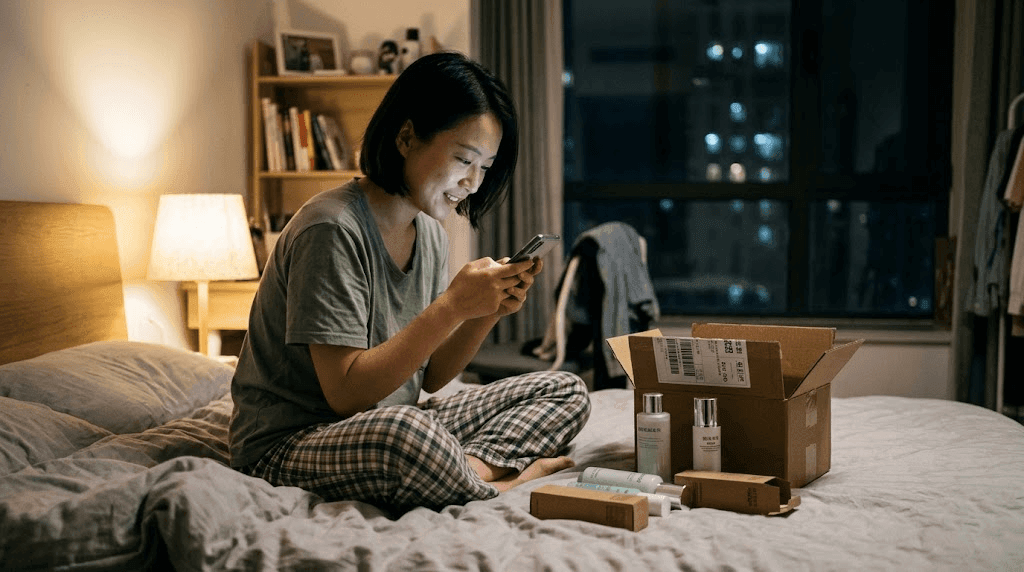
Opening the store takes weeks. Growing it takes years. We do the years.
Most foreign brands have a Tmall Global or JD Worldwide store. Few have one that grows. We run flagship stores every day, with one senior lead on call.
Two things to know before we touch your store
A cross-border store in China is a daily product, not a quarterly project. Here is how that shapes the way we work.
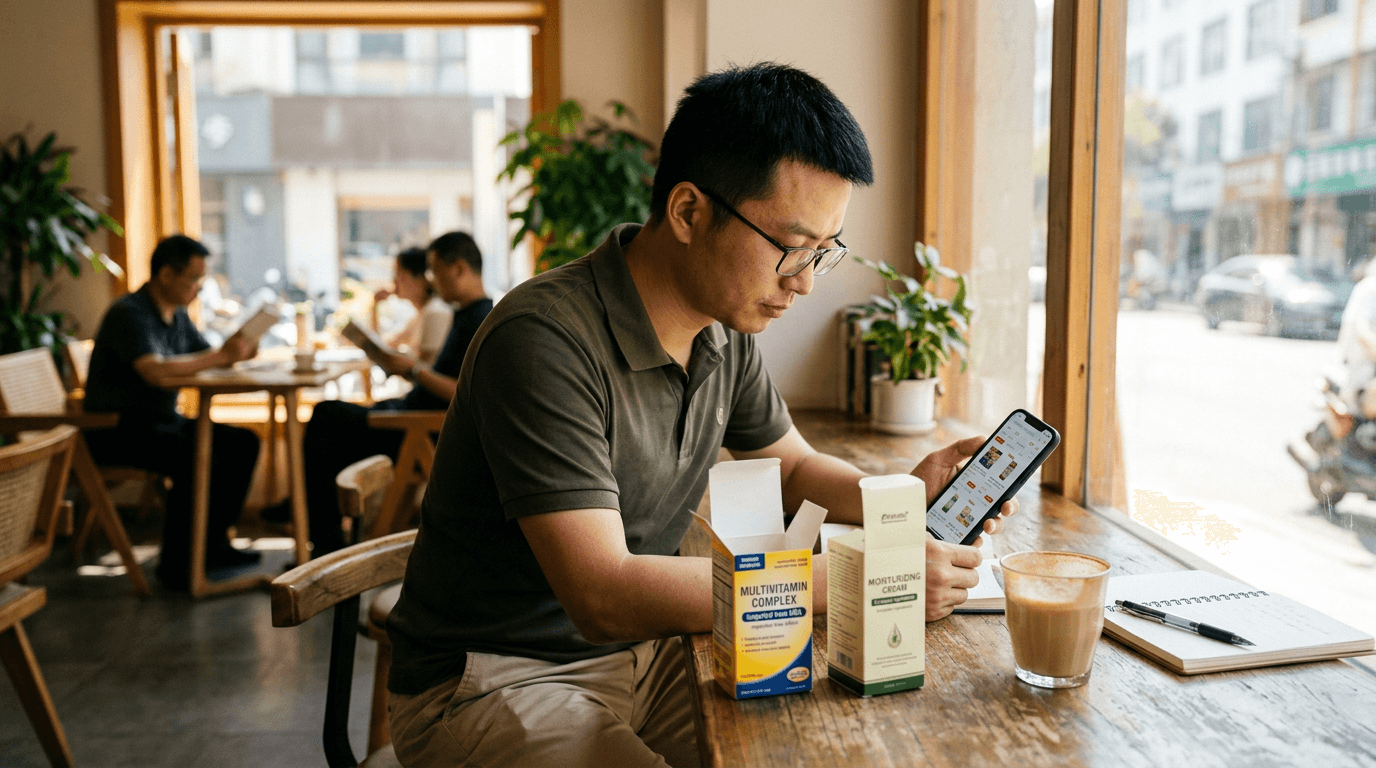
Strategy + ops in the same room
The team that wrote the plan stays on the store
Most agencies split strategy from execution. We keep both under one roof. The senior who wrote the plan runs your weekly ops sync.
- Strategy
- Planning
- Operations
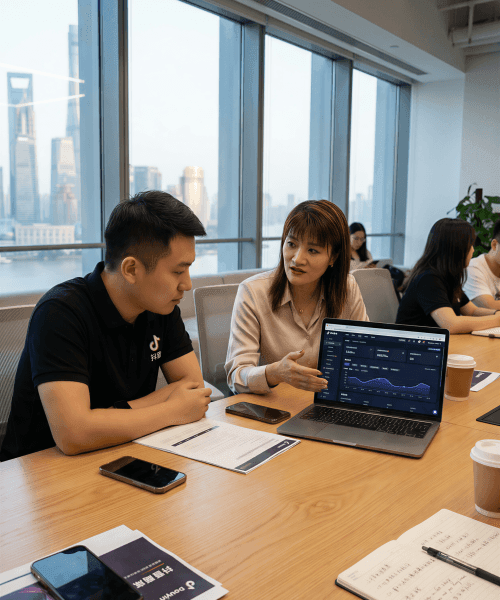
Senior leads, ten years on platform
Operators first, strategists second
Our senior team ran Tmall and JD stores at Publicis Commerce China. They have lost a Double 11 and won the next one.

Who owns the inventory. Two ways we run your store.
The first commercial question on any cross-border store is who owns the stock in the bonded warehouse. That answer shapes the contract, the margin and how you book China revenue. We work in two models. Pick the one that fits how you want China on your books.
TP model
You keep the stock on your books and the customer relationship in your name. We act as your Tmall Partner, JD Partner or Douyin EC partner. Operations, content, media, livestream, customer service: all run by us, all under your brand.
You want the China P&L on your own books, you want to build long-term brand equity in China, and you have the working capital to fund inventory in the bonded warehouse.
- Inventory Yours, in a bonded warehouse
- Store license Yours
- Customer data Yours
- Content, media, contracts Yours
- Media spend 100% funded by you
- Revenue Direct-to-consumer GMV, on your books
- Full retail margin on every sale
- Direct visibility into customer data and CRM
- Brand control across the entire storefront
- Monthly P&L review with the senior leads
- Daily store operations, merchandising, listing updates
- Paid media across Alimama, JD media and Douyin Qianchuan
- Livestream, KOL and KOC campaigns within the eCommerce platforms
- Mandarin customer service and review moderation
- Platform compliance, takedowns and penalty negotiation
Distributor model
We buy your product at wholesale and own the stock in China. The store is operated under our license, the inventory sits on our balance sheet, and we carry the commercial risk. You sell to us, we sell to the consumer.
You already have brand awareness in China, you want China revenue without China complexity, you do not want to fund inventory or carry stock risk, and you want a single accountable partner buying your product and selling it through. New-to-market brands rarely fit this model.
- Inventory Ours
- Store license Ours
- Customer data Ours
- Content, media, contracts Ours
- Media spend Brand budget + BBG co-invest
- Revenue Wholesale invoice, recognised as B2B

- Wholesale revenue with no inventory risk
- A single B2B invoice instead of a complex direct-to-consumer P&L
- No working capital tied up in China stock
- Aggregated performance reporting and category insight
- Inventory purchase, financing and warehousing
- Everything in the TP model, plus the commercial risk
- Pricing strategy across platforms within agreed brand guardrails
- Returns, refunds, customer service liability
One question, two answers
Do you want to own the customer relationship in China, or do you want a clean wholesale exit? That is what decides the model.
| TP model You own the inventory | Distributor model We own the inventory | |
|---|---|---|
| Who owns the inventory | You | BBG |
| Who owns the store and the data | You | BBG |
| Working capital you put in | High | None |
| Revenue you book | Retail GMV minus fees | Wholesale price |
| Margin upside | Full retail margin | Capped at wholesale |
| Risk you carry | Stock and demand | None on inventory |
| Media and promotion costs | 100% on you | Brand budget + BBG co-invest |
| Brand equity in China | Yours, fully | Yours, built through us |
| Best for | Brands building long-term China P&L | Brands already known in China |
The model that fits depends on two things: how big you want China to be in your global revenue, and how much cash flow you can put behind that ambition. Brands with high ambition and the working capital to fund inventory and media usually pick TP. Brands wanting steady China revenue without tying up cash usually pick distributor. Some brands run both in parallel across different categories. None of this is a maturity ladder.
One country, ten playbooks
Beauty needs RED seeding plus a Tmall Global flagship. Supplements run on JD Worldwide. Premium F&B wins on Douyin livestream. Electronics belong on JD. Each category has its own platform logic.
Which model fits depends on what you sell. The cross-border platforms do not reward one playbook.
- Where each category lands
- BeautyRED seeding + Tmall Global flagship
- SupplementsJD Worldwide for trust signal
- Premium F&BDouyin EC Global livestream
- FashionTmall Global + RED influence
- ElectronicsJD Worldwide
- Pet, home, lifestylePlatform mix per category
The three lines that hit your P&L
Agency, platform, brand. Every cross-border P&L lives on those three lines. We put real numbers behind all three before you sign anything.
What you pay us
per month
+ 10% on GMVMonthly retainer starting from $7,500 plus a 10% revenue share on GMV, with movement up or down depending on category and platforms covered. Media and content production billed at pass-through.
What you pay the platforms
commission, top end
Pass-through, never marked upPlatform fees on Tmall Global and JD Worldwide come straight off the official Chinese-language fee schedule, not estimated. Three buckets to plan for.
- Annual platform fee Fixed
Fixed annual fee plus a refundable deposit on Tmall Global. JD Worldwide runs similar brackets.
- Transaction commission 2 to 5%
Roughly 2% to 5% on each sale. Beauty and supplements at the high end. Hard goods at the low end.
- Payment gateway Per txn
Alipay and WeChat Pay each take a small percentage on every transaction.
What you put behind the brand
on you
From $120K in year oneYou fund 100% of media, content and promotion. We execute against your approved budget. Every yuan flows through your platform account, fully visible to you.
Your margin stays your margin. We are paid by you on TP, by the retail price on distributor.
- Alimama kickbacks
- JD commissions
- KOL agency rebates
We model the exact numbers and the split for your category in Phase one of the engagement, before any commitment.

Four phases from store to scale
A structured engagement that moves you from "we have a store" to a store that grows month on month. Phases one to three are sequential. Phase four runs on a loop, and we revisit phase one inside it every twelve months.
- Phase one (2 to 3 weeks)
Audit and growth diagnosis
We pull the store apart and rebuild the picture across traffic, conversion, retention, content and media efficiency. You walk away with three ranked growth levers, the numbers behind them, and a 90-day priority plan.
- Phase two (4 to 6 weeks)
Store and content rebuild
New PDPs, new banners, new video, a working livestream room. The store starts looking like it sells in 2026, not 2021, and the content survives platform algorithm changes.
- Phase three (4 to 8 weeks)
Media and traffic activation
Paid search, paid display, paid livestream, KOL and KOC. We turn on the taps across Alimama, JD media and Douyin Qianchuan, with RED seeding feeding the upper funnel. Every yuan tied to conversion.
- Phase four (Always on, annual reset)
Operations and scale
Daily operations, weekly optimisation, monthly business review, quarterly campaign planning. We run the calendar (618, 99, 11.11, Double 12, Chinese New Year) and reset the priority list with a fresh audit every twelve months.
Powered by TheRedScroll
Our cross-border stores convert better when content is live across the China social stack. TheRedScroll is our sister agency for daily WeChat, RED, Douyin and Weibo operations. Built to feed your store with attention, not just impressions.
Run your store and your social on the same rhythm.
Cross-border stops working when the content goes quiet. TheRedScroll keeps the off-platform channels active every day, while we run the stores. Same group, same standards, separate brand.
- 25+ years of Chinese social experience inside the group
- 4 channels covered: WeChat, RED, Douyin, Weibo
- In-house native team, content shot in studio
Always-on social
Daily WeChat, RED, Douyin and Weibo run alongside your flagship store. For brands whose store is live and needs constant content fuel.
Launch sprint
A three-month intensive across all four channels around a Tmall Global or JD Worldwide launch. For the opening wave.
Festival drive
Campaign-specific social activation for 618, 11.11, Double 12 or Chinese New Year. For brands where the calendar moment matters more than the always-on cadence.
Most agencies hand you an account manager. We hand you an operator.
Our team ran eCommerce at Publicis Commerce China for global brands across Tmall, JD, Douyin and RED. We run what we recommend.
The senior who writes the plan is on the call when the store hits a problem.
We test what platforms reward every week. We book the KOLs we recommend. We shoot the content that sells, in our own studio.
Meet the team- What you can expect
-
Senior operators on your account, every day
Cyril or Liyan in your kickoff, your monthly review and your war room. Not just at pitch.
-
One team across store, media, content and livestream
Not four agencies, four briefs and four invoices. One owner of the P&L.
-
Transparent fees, no platform kickbacks
We are paid by you. Not by Alimama. Not by JD. Not by KOL agencies. Your margin stays your margin.
Twenty questions, answered straight
The practical questions we field from brand managers, eCommerce directors and founders running cross-border in China. Filter by topic.
Operations What does running a Tmall Global store actually involve day to day?
More than people expect. Daily store updates, banner swaps, promotion setup, inventory sync with the bonded warehouse, Mandarin customer service, order checks, returns, review moderation, livestream prep. A flagship store left untouched for a week loses ranking. Leave it untouched for a month and it loses category position. The work is steady, not glamorous, and it is what separates the stores that grow from the ones that just exist.
Operations How fast can you take over an existing store?
Two to four weeks for an audit and clean handover. Longer if the previous partner is uncooperative (it happens). We pull everything first: backend access, media accounts, customer data, content library, supplier contracts. Then we map what is missing. We run two weeks in parallel before cutting over, so you do not lose a campaign window in the transition.
Operations Do you handle customer service in Mandarin?
Yes. Native Mandarin team working platform hours (9 a.m. to 11 p.m. local time, longer during 11.11). Tmall Global, JD Worldwide and Douyin EC Global all measure response time and bake it into your store score. We hold response time under 30 seconds and we keep ratings above platform average.
Operations How do you handle logistics and bonded warehouse?
We coordinate with your existing bonded warehouse provider, or we introduce one if you do not have one. Most Tmall Global brands run through Cainiao bonded warehouses. For JD Worldwide, JD’s own bonded network is usually the faster route. We track stock, file customs, handle returns and chase delays. Logistics is not glamorous. It is just the difference between a 4.9 store rating and a 4.5.
Operations What happens when an SKU sells out mid-campaign?
We flag it before it happens. Stock reorder triggers are set in the dashboard. If you cannot replenish in time, we shift the campaign weight to a sister SKU, redirect paid media, and protect the store rating with a clear holding page. The worst outcome is a silent stockout, and we make sure that does not happen.
Operations How do you handle returns and fake reviews?
Returns are managed by the bonded warehouse partner under our coordination. Return rates typically run 8% to 15% in beauty, 15% to 25% in fashion, under 5% in F&B and supplements. Fake reviews and review-bombing attacks happen, especially after a viral moment. We monitor daily, file removal requests with the platform, and seed genuine customer reviews through our KOC network.
Platforms Which platform should I run first?
Depends on category, brand maturity and content readiness. Tmall Global is the default for beauty, supplements, F&B and lifestyle, where brand trust matters most. JD Worldwide wins on electronics, home, male-skewing categories and consumables that benefit from JD logistics. Douyin EC Global is the right call when content is your strength and you can produce livestream every day. We pick the right one in Phase one, not by default.
Platforms Can we run Tmall Global and JD Worldwide at the same time?
Yes, and most brands at scale do. Tmall Global usually carries the brand flagship. JD Worldwide picks up logistics-sensitive categories and male shoppers. Be ready for double the operations workload, double the campaign cadence, and a clear pricing strategy across both. We run multi-platform accounts every day.
Platforms What about Douyin EC Global?
Growing fast. Douyin closed the gap on Tmall Global across beauty, F&B and lifestyle in 2025 and 2026, because livestream is the format where conversion sits highest. The catch is content production: daily livestream, weekly creative refresh, constant short video. Brands without content discipline burn money on Douyin. Brands that have it, win.
Platforms Where does RED (Xiaohongshu) fit?
Discovery, not transaction. RED is where Chinese consumers research before buying on Tmall Global, JD Worldwide or Douyin EC Global. We use it for KOC seeding, brand reputation and demand creation. In-app commerce on RED is still small for cross-border. The standard play is RED for influence and Tmall Global or JD Worldwide for conversion, though some categories now flip that order.
Performance What growth should I expect in year one?
Depends on category, starting point and budget. New flagship stores on Tmall Global or JD Worldwide typically land their first full year between $400,000 and the low single-digit millions in GMV, depending on media spend and category. Relaunched stores with an existing baseline tend to grow 30% to 80% in the first twelve months under our operations. Anyone quoting a single number without seeing your category and budget is selling, not advising.
Performance When do we see results?
First metrics shift in week six (conversion, traffic mix, content engagement). Revenue shifts usually land in month three or four. The first big campaign window after takeover (618, 99, 11.11) is where the real number prints. Cross-border in China rewards patience, not impatience.
Performance How do you report?
Live dashboard you can open at any time (traffic, GMV, ROAS, conversion, repeat rate). A weekly written summary covering what moved and what is next. A monthly senior business review on video with Cyril or Liyan. A quarterly planning session. No PDFs that arrive a week late. We share the same dashboard we use internally.
Compliance What if my product cannot be sold through cross-border?
We tell you before we sign. Some products do not qualify (restricted categories, certain medical claims, formulation issues). If yours is one, we say so in week one, and we either help you reposition or recommend a different route to market. We do not run stores for products that will get pulled six months in.
Compliance What about platform takedowns or penalties?
We handle them. A penalty notice on Tmall Global or JD Worldwide has to be answered within 24 to 72 hours depending on severity. Our ops team handles the response, the rectification plan and the platform negotiation. Penalties happen, even at top brands. What matters is how fast you recover.
Contract What is the minimum engagement length?
Twelve months for the TP model. Twenty-four months for the distributor model. Cross-border stores need time to ramp, especially through the first major campaign window, and an inventory commitment needs a longer runway to recover. Shorter engagements are possible for project-based work (618 sprint, 11.11 sprint, launch sprint) but not for always-on operations. Anyone promising always-on results inside three months is signing you up for a poor outcome.
Contract Who owns the store license, customer data and content?
Depends entirely on the model. In the TP model, you own everything: store license, customer data, content library, media accounts and supplier contracts. We run operations under your brand and your assets. Nothing transfers at exit because nothing was ever ours. In the distributor model, we own everything: the store, the inventory, the customer data, the content and the media accounts. You sell to us, we sell to the consumer. Brand IP and trademarks stay yours, naturally, but the China commercial infrastructure sits on our side.
Team Who runs my account day to day?
A dedicated senior account director, a store operations lead, a content producer and a media buyer. They are full-time on China cross-border, not splitting their hours across five clients. Cyril or Liyan join the monthly review and step in on commercial calls.
Team Where is the team based?
Native team based in mainland China, working platform hours. Senior leadership splits time between China, Hong Kong and Paris. You get one inbox, one Slack channel, and a working day that overlaps with both China and Europe.
Team Do you work with my global agency or in-house team?
Yes. We slot into existing brand frameworks and we share what we learn back to your global team. We do not try to wedge ourselves into work that is already covered elsewhere. The brief from week one is to run the China stores, not to redo the global plan.
Running a store today, or about to open one?
Tell us where the store is today and what it needs to be doing six months from now. A senior member of the team replies within one working day. No funnel. No auto-responder.