

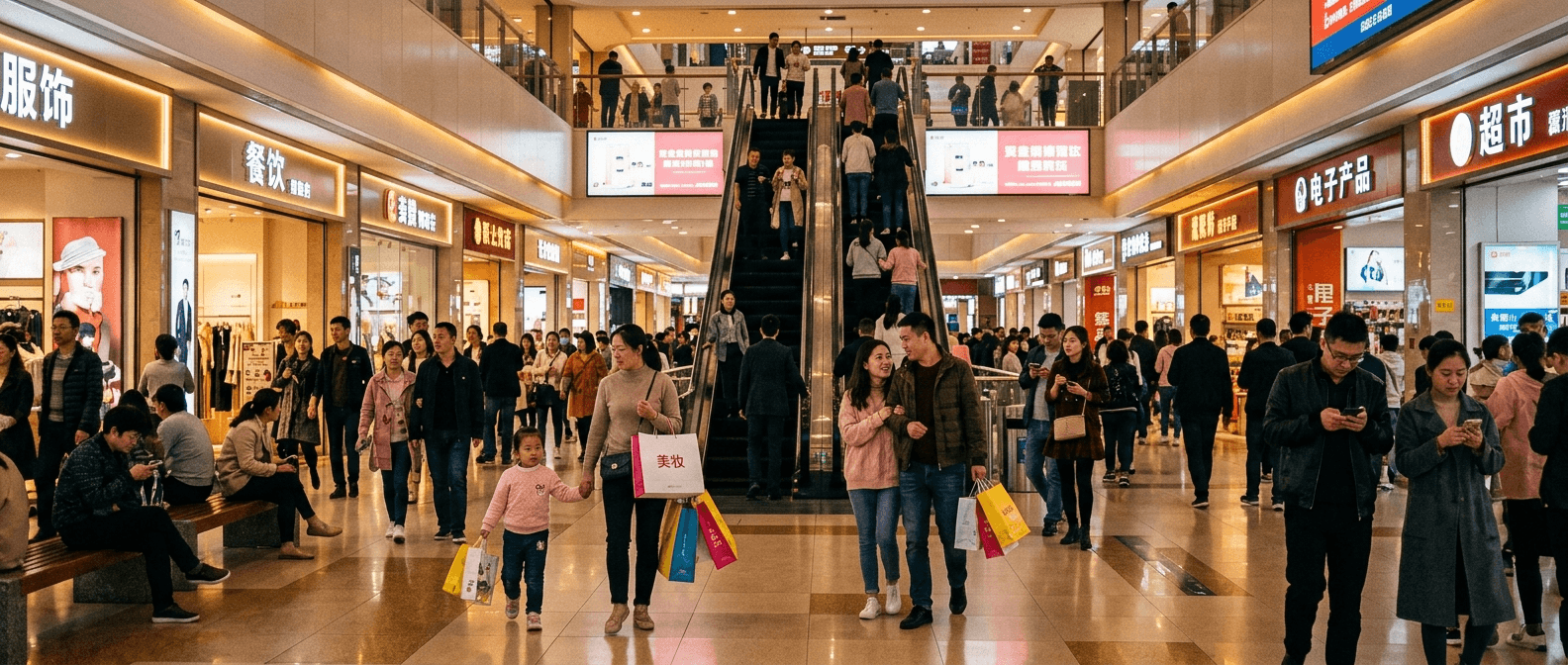
China market entry is complex and crowded. We make the path clear before you build.
We design China market entry blueprints for global brands. Feasibility, financial models, competitor analysis, and distributor partnerships. The architecture before the construction.
Two things to know before we start
Most brands approach China the way they approach any new market. China does not reward that approach. Here is what shapes how we work.

Strategy that gets used, not filed
Most market entry decks describe the market. Ours tells you what to do on Monday morning. Every recommendation is built from operational reality, not desk research, and tested against the platforms and partners you will actually work with.

Architects of the entry, not the building
Think of us as the architects, not the contractors. We design the blueprint, source the partners, set up the framework. You decide if and when to build. No pressure to launch, no incentive to oversell the case.
Most China consultants have never run operations there. We have.
Our team comes from Publicis Commerce China. We built the eCommerce practices for GSK, Nestlé, Ferrero and Beiersdorf across Tmall, JD, Douyin and RED.
We consult based on operational experience, not research reports.
We know which distributors perform because we have evaluated them. We know what platforms require because we filed the applications ourselves.
Meet the team- What you can expect
-
Decisions backed by operational experience
Every recommendation tested against the platforms, the regulations and the partners you will work with on the ground. Not desk research.
-
Phased commitment, not all-in upfront
Engage one phase at a time. Stop if the answer changes. You stay in control of scope and spend.
-
Independent distributor sourcing
We do not take commission from distributors. Your interests, not theirs, sit on our side of the table.

Sell in, or sell out. Two routes into China.
Your China market entry strategy hinges on one decision: partner with a distributor, or build your own operations. We help you choose the route that fits your capital, timeline and ambition.
 Sell in
 Distributor partnership
Validate without committing.
You sell products to a qualified CBEC distributor at wholesale pricing. They purchase inventory, own operational risk, and manage all in-market operations.
- Capital needed Low
- Risk you carry Low
- Time to market Fast
- Brand control Shared
- Wholesale revenue
- Zero inventory risk
- Immediate cash flow
- Limited capital commitment
- Platform operations on Tmall Global, JD Worldwide, Douyin
- Marketing and content
- Logistics and bonded warehouse
- Customer service in Mandarin
You are validating market fit, you do not have an Asia team, or your category calls for specialised local expertise you would rather rent than build.
 Sell out
 Direct operations
Commit to control.
Your brand owns the complete China operation. You finance inventory, control all touchpoints, and manage platform and logistics relationships.
- Capital needed High
- Risk you carry High
- Time to market Slow
- Brand control Full
- Full retail revenue
- Complete brand control
- Customer data ownership
- Pricing autonomy
- Inventory financing
- Platform fees and operations
- Marketing execution and media
- Operational costs (warehouse, returns, service)
You have proven demand, the China P&L is a strategic priority, and full control of pricing, customer data and brand positioning justifies the capital and the complexity.
One question, two answers
Are you validating, or are you committing? That tells you which route to take. Most brands start in one and move to the other once the case is proven.
Four phases from question to answer
A structured engagement that moves you from "should we enter China" to a decision-ready plan. Each phase ends with deliverables you can act on.

Market and regulatory diagnosis
We evaluate whether your product can legally sell through Cross-Border eCommerce and assess the competitive landscape.
You know if your product can legally land in China, and at what cost.
- CBEC eligibility assessment (formulation, packaging, labeling compliance)
- Regulatory environment analysis and compliance requirements
- Competitive landscape mapping and positioning analysis
- Market opportunity sizing with realistic demand projections
- Feasibility and compliance checklist
- Competitor benchmark report
- Price positioning analysis
- Opportunity sizing model

Channel and consumer model assessment
We assess platform options and determine which distribution model makes commercial sense for your product.
You know which platforms fit, and which distribution model makes the math work.
- Platform evaluation (Tmall Global, JD Worldwide, Douyin, RED)
- Bonded warehouse vs. direct-mail logistics assessment
- Consumer price sensitivity analysis
- Platform-specific requirement mapping
- Channel matrix with platform strengths
- Operations flow diagram
- Pricing validation across models
- Consumer insight report

Competitor deep-dive
We analyze how successful brands operate in your category across the dimensions that move the needle.
You know who you're up against, how they price, and where the white space is.
- Portfolio structure analysis (device coverage, SKU breadth)
- Pricing ladder mapping (price points, promotional mechanics)
- Bundling strategy evaluation (AOV tactics)
- Store presence audit (merchandising on Tmall and JD)
- Content and social analysis (proof formats, platform strategies)
- Competitor benchmark book (deck)
- Competitor scorecards (1 page each)
- Competitor eComm data tables (Excel)

Financial model and strategy blueprint
We build the complete business case with transparent cost structures and a decision-ready recommendation.
You have a board-ready Go or No-Go with the numbers behind it.
- Import cost modeling (COGS and cross-border logistics)
- Platform and payment fee structures
- Distribution model comparison (Sell-in vs. Sell-out economics)
- Marketing budget framework
- 12-month roadmap development
- China Market Entry Blueprint (deck)
- Financial model with scenarios (Excel)
- Go or No-Go recommendation
Powered by BeyondCompass
Choose the sell-in route and the next question is which Chinese distributor to trust. BeyondCompass is our answer. A partner database built over twenty years. Distributors, Tmall third-party providers, Douyin partners, importers. Hand-vetted, met in person, kept current.
Skip three months of sourcing. Find the right China partner first.
Most distributor lists in China are scraped. A thousand names by lunchtime, almost none right for your brand. BeyondCompass replaces that with a curated shortlist, backed by two decades of meetings across five categories: beauty, food and beverage, fashion, wellness, pet.
- 0 years of vetted relationships
- Five categories: beauty, F&B, fashion, wellness, pet
- Seven offices and reps in China, Europe and the US
Three to five vetted names, tuned to your category and stage. Delivered in two to three weeks.
Right when you know the brief and need the introductions, fast.Fifteen to twenty comparable options across the landscape. Delivered in three to six weeks.
Right when you want the full picture before you commit.Unwind an underperforming partner. Source the next one. Manage the handover.
Right when the relationship has stopped working and you need a clean exit.Twenty questions, answered straight
The practical questions we field from founders and operators considering a China entry. Filter by topic.
Strategy What is Cross-Border eCommerce (CBEC)?
CBEC lets you sell to Chinese consumers without setting up a Chinese entity. Products ship from bonded warehouses or by direct mail, and customs clears at the consumer level. You get access to JD Worldwide, Tmall Global, Douyin and RED. You do not get offline retail, and you do not get domestic eCommerce until you complete NMPA or SAMR registration. Most brands use it as a lighter way to test demand before committing to full infrastructure.
Strategy Which distribution model should I choose, sell-in or sell-out?
Start with sell-in if you are still validating the market. A qualified distributor buys your inventory at wholesale, owns the operational risk, and your team stays focused on global. Move to sell-out once demand is proven and you need full control over pricing, customer data and brand experience. A lot of brands we work with start sell-in for 18 to 24 months, then transition. Some never do, and that is fine if the distributor performs.
Strategy What if the answer is "do not enter China right now"?
It happens. Roughly one in four engagements ends on a No-Go. Bad timing, wrong product fit, regulatory cost too high, the category already crowded. We tell you why, what would need to change, and when to revisit. You still get the full analysis. A clear No saves you twelve months and several million euros you would have burned figuring it out the hard way.
Strategy Can you guarantee my brand will succeed in China?
No. Nobody can. We can tell you whether the market math works, whether your category is winnable, and which model gives you the best odds. Execution still depends on your product, your patience, and your willingness to adapt. Anyone who promises a guarantee is selling you a story.
Strategy Why work with you instead of a Big Four firm?
Big Four delivers great frameworks. We deliver the answer plus the operator who can build it. Our team has run Tmall stores, handled platform takedowns, negotiated with distributors, and shipped through bonded warehouses. When you ask us about CBEC compliance, you are asking someone who has filed the paperwork, not someone who read about it. Most of our work picks up where a strategy deck stopped helping.
Compliance Can my product sell through CBEC?
Depends on what you sell and what you claim. Anti-aging cosmetics need NMPA special-use registration. Health supplements with functional ingredients need SAMR approval. Medical devices have strict classifications. Foods are restricted by ingredient. Phase 1 of our engagement checks CBEC eligibility before you spend another euro on the project.
Compliance What if I cannot use my home market product claims in China?
Common problem. "Diabetic wound care" becomes "fragile skin daily care." "Immune support" may need full health-food registration. "Clinically proven" usually has to be rewritten. We adapt positioning to fit platform rules without throwing out the brand equity. The trick is knowing what passes review before you build the launch around it.
Compliance What if my product was already rejected by a platform?
We pull the rejection notice, identify what triggered it, and tell you whether repositioning fixes it, whether a different platform works, or whether the product really cannot enter through CBEC. Sometimes the fix is a label change. Sometimes it is a Chinese formula adjustment. Sometimes it is a hard structural No. We give you the real answer instead of pretending the rejection did not happen.
Compliance What happens if Chinese regulation changes mid-engagement?
We flag the change, pause the affected workstream and reassess. Recent examples include the 2021 cosmetic regulation overhaul, the 2023 NMPA updates, and ongoing CBEC positive-list revisions. Our compliance partners track this daily. If a new rule reopens or kills your case, we tell you immediately and adjust the plan, not at the end of the engagement.
Process What information do you need from us to start?
Product specs, packaging artwork in editable format, current home-market pricing, regulatory certificates you already hold, your China objective, and your timeline. More detail upfront means a faster Phase 1. If you do not have everything, that is OK. We work from what you have and flag the gaps.
Process How long does the full engagement take?
Phases 1 and 2 together run roughly 6 to 8 weeks. Phase 3 competitor deep-dive runs 4 to 6 weeks in parallel. Phase 4 financial model adds 3 to 4 weeks. From kickoff to a clear Go or No-Go, you are looking at 10 to 14 weeks. If you want us to source and negotiate a distributor on top of that, plan another 8 to 12 weeks.
Process What do I get at the end of the engagement?
A board-ready package. Feasibility and compliance report. Competitive benchmark book with one-pagers per competitor. Full financial model in Excel with scenario planning. Channel strategy with platform-specific recommendations. A clear Go or No-Go recommendation. If you add the distributor track, a signed term sheet or contract with a vetted partner. Everything in English. Translated assets on request.
Process What happens if a finding kills the business case mid-way?
We stop and talk to you, not to the file. If Phase 1 surfaces a compliance issue that breaks the case, we will not run Phase 4 and bill you for the model. We adjust scope, refund the unused portion, and you walk away with what you have. The engagement is structured in phases for exactly this reason.
Cost What does this cost?
Fees depend on scope and which phases you take. We structure as fixed-fee per phase, not hourly. Most full engagements through Phase 4 land between eighty and two hundred and twenty thousand euros. Distributor sourcing, if you add it, is quoted separately, usually a project fee plus a success component. We share full pricing once we have scoped the work in the first call.
Cost Do you take a commission from distributors you introduce?
No. We bill you on the engagement. The distributor does not pay us referral fees. That is deliberate. If we took commission, our incentive would flip toward closing a deal instead of finding the right partner. You can verify this in the contract. Some clients ask. We are glad they do.
Cost What is the typical budget needed to launch after the engagement?
Cross-Border launch through a distributor: from around two hundred thousand euros in working capital, then growth spend from there. Sell-out direct on Tmall Global or JD Worldwide: eight hundred thousand to one and a half million euros over the first twelve months for store setup, content, media and inventory. We model the exact number for your category in Phase 4 so you are not budgeting blind.
Operations How do you source distributors?
Our network covers beauty, consumer tech, F&B, mother-and-baby, premium home and select health categories. We start from a longlist of 8 to 12 names, screen for category track record and platform credentials, then sit with you to pick the 2 to 3 finalists you actually meet. We sit on your side of the table for the commercial negotiation.
Operations How much of my team's time will the engagement need?
Lighter than most clients expect. Roughly two hours a week from your project lead during Phases 1 to 3. Three or four working sessions of half a day each across the engagement. More involvement if you add the distributor track, because you are the one meeting the partners. We do the heavy lifting on research and modeling.
Legal Do I need a legal entity in China?
Through a distributor, no. They use their own licenses and assume the regulatory burden. For direct CBEC operations, yes, but not necessarily your own company. Chinese rules require any foreign brand selling through CBEC to designate a domestic service provider (境内服务商) who files with customs and assumes joint liability. You can set up your own WFOE or partner with a qualified third-party service provider. We help you decide which fits.
Legal Who owns the strategy and the data once the engagement ends?
You do. All deliverables, models, competitor data, distributor research and contract templates transfer to you on completion. No retention clauses on the strategy. We do not resell findings to competitors, which is also written into the contract. Common-sense ownership, not legal trickery.
Thinking about expanding your brand to China?
Tell us where you are today and where you would like to be. A senior member of the team will reply within one working day. No sales funnel, no auto-responder.